
Dr. Nathan S. French
Miami University
Picture, for a moment, a response to a tragic event. Often, we will see people post online about their “thoughts and prayers” being with those affected. We might see calls to donate funds or other forms of support to those harmed. How often have you seen religious or spiritual responses –of any particular faith, or even none –to tragic events?
Following the attacks on the United States on September 11, 2001, many Americans of varying faiths — and none–turned to what scholars might consider forms of religion or spirituality to make sense of the tragedy and find the resilience to recover and rebuild. This might have occurred in congregations, but it also occurred throughout the daily lives of Americans, who walked by small memorials, posted and circulated prayers, or checked in on their neighbors. Other Americans experienced those days a bit differently, especially if they felt that their expression of their faith and spiritualty had been called into question by the attacks.
Of course, religious leaders worked tirelessly to meet the needs of their parishioners, congregants and the needs of members of the general public who, perhaps, had not thought of religious or spiritual questions in some time. For many American Jewish communities, entire congregational talks had to be re-written by rabbis, as the attacks occurred during the Jewish High Holy Days. This difficult and emotional work took its toll on various clergies, too, with one study noting that over 75 percent of Presbyterian ministers reported posttraumatic stress symptoms in the days following the attacks.
What might Americans’ responses to September 11 teach us about religion, citizenship, and who belongs in the American “we”?
Institutional Responses — Civil Religion, Cathedrals, and Stadiums
Three days after the attacks, the Washington National Cathedral held a “National Day of Prayer and Remembrance” service gathering President George W. Bush; former presidents George H.W. Bush, Bill Clinton, Jimmy Carter, and Gerald Ford; sitting members of Congress, assorted foreign diplomats, and religious leaders from several diverse backgrounds of belief and practice.
In many ways, the service was reflective of what sociologist of religion Robert Bellah once identified as the “civil religion” of the United States, a tradition which, while not distinctly Christian, draws upon a generic, overarching spiritual langauge that often suggests the United States enjoys a special relationship to a higher power, a conviction that the nation’s history is responsive to a divine law or will, and the idea that the nation has a specific blessing or mission that is ordained for it in the world.
Following readings and remarks by faith leaders from Christian, Jewish, Buddhist, Muslim, Sikh, and Hindu traditions, the Rev. Billy Graham, a Southern Baptist evangelist, delivered a confessional, Christian homily, in which he sought to assuage his audience that though the events of 9/11 were representative of the “mystery and reality of evil,” there was “hope for the present because … the stage has already been set for a new spirit in our nation.” Calling for a spiritual renewal of the United States — a return to the nation’s collective commitments to prayer — Graham concluded that as God would guide President Bush, so too would God guide Americans to rebuild their trust in God.
At the close of his remarks, which followed Graham’s, President George W. Bush offered a prayer: “We ask Almighty God to watch over our Nation and grant us patience and resolve in all that is to come. We pray that He will comfort and console those who walk in sorrow …. May He bless the souls of the departed. May He comfort our own, and may He always guide our country. God bless America.”
That phrase, “God Bless America,” appeared across the country in newspapers, advertisements, and bumper stickers. The song written by Irving Berlin in 1918 and gaining in popularity in 1938, was performed at a San Diego Padres game in 2001 after the resumption of competition following the attacks. That performance swept across the league, leading many teams to begin including “God Bless America,” as part of their seventh-inning stretch observances. The New York Yankees, for example, have either played or hosted a performance song at every single game since the 2001 season.
As Bellah observed, the American “civil religion,” thought it takes many forms, is often a form of memorialization and narrative storytelling. Such forms of storytelling are often an attempt to explain why certain events happen to the United States and what the appropriate responses of Americans should be. Equally, though, such acts of meaning-making can build particular ideas of who is — and sometimes who is not — American. Before 9/11, in Pew polling, most Americans thought that religion was losing influence in America. Two months later, however, nearly 4 in 5 believed that the influence of religion was growing. Not all experienced this shift in the same way.
One Washington-area secular humanist leader, for example, noted that it was difficult to participate in acts of national morning that centered churches, clergy, and prayer. Some Americans, such as Washington Post op-ed author Charles Krauthammer, questioned the sincerity of Imam Muzammil Siddiqi’s reading of the Qurʾan during the national prayer service and were met with substantial criticism and condemnation in response. At stake in many of these inclusions and exclusions were widespread debates about the rights, duties, obligations, and even appropriate faith commitments for Americans across the country.
Lived Religious Responses — Responding on Sidewalks, Street Corners, and Online
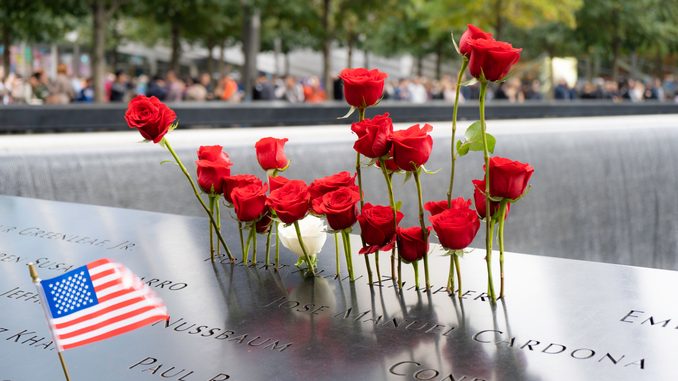
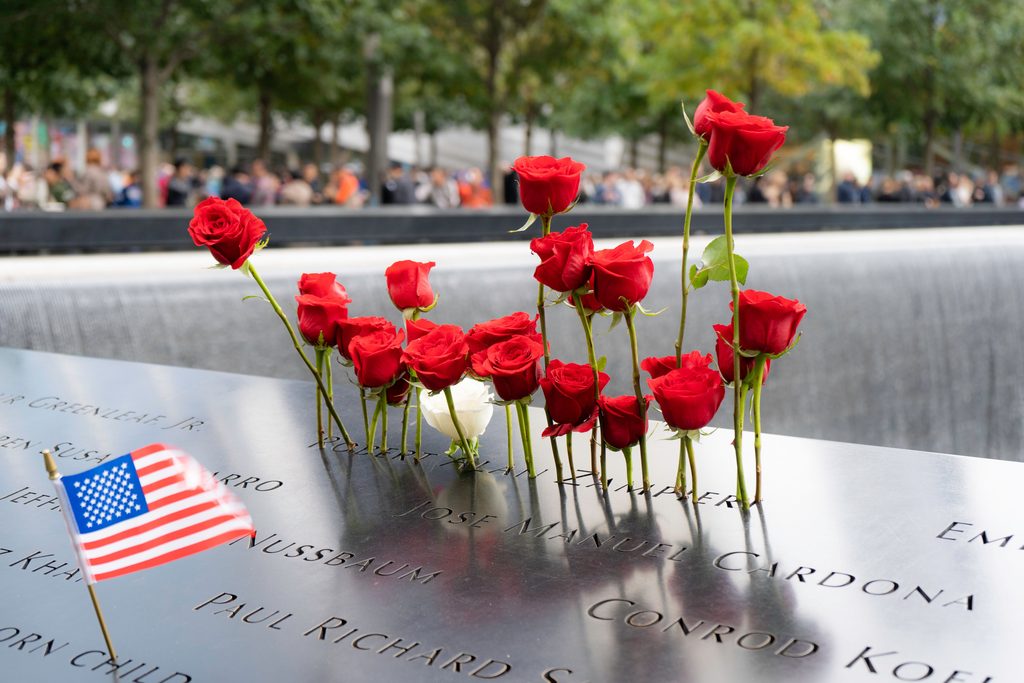
Outside of the doors of temples, cathedrals, mosques, and synagogues, however, the lived religious experiences of Americans reflected a diverse and broad series of religious and spiritual responses to the attacks. While news stories focused on Manhattan (and the boroughs of New York), Washington, D.C., and the fields of Shanksville, Pennsylvania, impromptu memorials of candles, flowers, photographs, missing-person posters, handwritten notes, and strangers silently standing beside one another or comforting one another spread across the country.
Many of these shrines included small Buddhist statutes, Catholic or Muslim prayer beads, Hindu statues, and votive candles. Most, however, were ephemeral, makeshift, and temporary. They gradually evaporated, scattered by winds and rain, as folklorist Jack Santino observed, which, in some sense, was part of their purpose. “The shrines,” he wrote, “insist upon the presence of absent people. They display death in the heart of social life …. [They show that] we are all family, mutually connected, interdependent.” They are a connection, he argues, between those living and lost that place those lost back into our lived contexts — “areas of commerce and travel, and into everyday life as it is being lived.”
The idea of “lived religion,” in conversation with these ideas, is one written about by the sociologist of religion, Nancy Ammerman. How were religion and spirituality lived by Americans outside of formal houses of worship after 9/11? For starters? Prayer and meditative reflection. Following 9/11, 69% of Americans said they were praying more following the attacks. For Americans with the internet, in addition to prayers and other invocations of God’s blessing for America, early internet memes began to circulate in the days after the attacks.
As recovery efforts unfolded, images circulated of a “9/11 cross,” a set of steel beams recovered from Ground Zero. Some claimed to see “Satan’s face” in the smoke billowing out of the towers. Others included an image of a pencil drawing of Jesus Christ seemingly gathering the faithful from the World Trade Center Towers. Yet, memorialization was by no means simply for those who identified as religious or spiritual. Those of no particular religious or spiritual affiliation attended candlelight vigils, volunteered, donated blood, participated in moments of silence, read victims’ names and participated in relief and recovery work alongside Americans of various religiosities.
Wearing Religion after 9/11
Four days after September 11, 2001, Balbir Singh Sodhi was shot and killed while planting flowers outside his gas station that he owned and operated in Mesa, Arizona in what his assailant claimed was an act of retaliation for the attacks. Seeing his turban, his assailant believed he was Muslim. Sodhi was a sikh.
Sikh Americans, along with Muslim Americans and those of several other faiths –and none –faced considerable discrimination after September 11, 2001 that has persisted, in varying forms, to present. A New Yorker cover, “What So Proudly We Hailed,” illustrated by Carter Goodrich, depicting a cab driver decorated with American flags, riding low so as not to be seen, captured some sense of this fear. As Anika Rahman, an American Muslim, wrote in the pages of the New York Times after the attacks, “I fear being hated and blamed by the very city I love … …. I am so used to thinking about myself as a New Yorker that it took me a few days to begin to see myself as a stranger might: a Muslim woman, an outsider, perhaps an enemy of my city.” Religious identity, for some Americans, was not lived through rituals or memorials, but through bodies — in a Sikh turban or Muslim hijab.
Yet Americans’ attitudes after 9/11 reveal an apparent paradox. Pew found that favorable views of Muslim Americans actually rose from 45 percent in March 2001 to 59 percent in November. At the same time, only 38 percent of Americans said they knew even “something” about Islamic beliefs and practices. Familiarity mattered: people who knew more about Islam were considerably more likely to view Muslim Americans favorably. However, for a generation of young Muslims, almost all families have a story to tell about their experiences with anger and fear from neighbors and co-workers following the attacks.
The events of September 11, 2001 both expanded and contested the boundaries of American religiosity. For some Americans, the events of that day were made sacred and were memorialized through prayer, sacrifice, flags, and small impromptu streetside sanctuaries built with candles, photographs, and small mementos of those loved and those lost. Yet, for other Americans, the events called into question their once closely held affirmations of American religious pluralism, leading them to ask, “Whose religions belong inside the American ‘we’ that opens the Constitution?”
Within a few months after the attacks, Americans seemed to return to a sort of “religious baseline.” By mid-November 2001, Pew polling found that the number of Americans who considered religion very important in their lives (61%) was not that dissimilar from the March 2001 (64%) number. Institutional religious attendance was also unchanged. By March 2002, only 37% of Americans felt that religion was “gaining” influence in American life, a direct parallel to the March 2001 number.
Each year, however, as Americans observe “Patriot Day” to commemorate the September 11, 2001 attacks, we often see a return to the memorials, the prayers, the sermons, and the shrines that Americans turned toward to make sense of a time when tragedy struck the country.
Questions for Classroom Discussion
- As noted above, many Americans believed that religion was becoming more influential after 9/11, even though their own religious commitments change very little. Why might this be the case? What might this help us understand about “civil religion” in America?
- Think about the various commemorations that you have experienced of September 11, 2001 or other major events. Can practices such as lighting candles, visiting memorials, flying flags, donating blood, or observing moments of silence be religious for some people and secular for others? What makes such actions “religious” or not?
- Do democracies have need for these sorts of public rituals? Why or why not?
- Think about the rituals of U.S. life with which you’re familiar — the Pledge of Allegiance, the National Anthem, or others. How might these rituals be unifying? Are they always? What happens if citizens or others refuse to participate?
- Does “religious freedom” as a concept and principle require anything beyond mere constitutional protections? In everyday democratic life, what responsibilities do citizens have toward neighbors whose religions, appearances, or beliefs differ from their own? How might this change or be challenged after national tragedies like 9/11?
Further Resources
National 9/11 Memorial & Museum, “What Happened on 9/11 Part I” (link) and “What Happened on 9/11, Part II” (link)
National 9/11 Memorial & Museum, “Muslims in America,” Parts I (link), II (link), and III (link)
The Library of Congress, “The September 11, 2001 Documentary Project,” (link)
PBS, “Faith and Doubt at Ground Zero,” September 3, 2002, (link)
PBS, “Religious Reactions to Terrorism,” September 14, 2001 (link)
The Pluralism Project, “Islam in America Post 9/11,” Harvard University (link)
StoryCorps, “Remembering Balbir Singh Sodhi,” audio and transcript (link)
Leave a Reply